Connected IoT devices and wireless sensor nodes
On-board radio: Wi-Fi 802.11b/g/n 2.4 GHz; Bluetooth 5 LE.
Engineering inference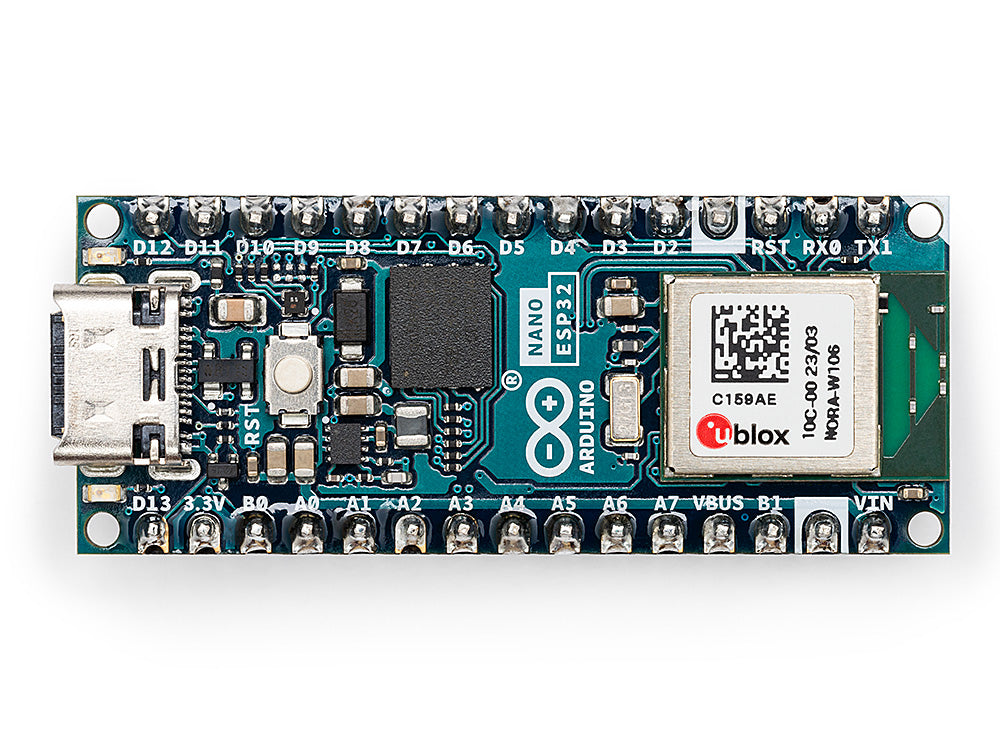
Arduino S.r.l.
Nano-form-factor (ABX00083 = with pre-soldered headers) ESP32-S3 board (u-blox NORA-W106-10B: dual-core LX7 240 MHz, 512 KB SRAM, 8 MB octal PSRAM, Wi-Fi 4 + BLE 5, built-in antenna) with 16 MB QSPI flash, USB-C, RGB LED, 3.3 V IO, 6–21 V VIN buck; MicroPython/Arduino Cloud ready.
ABX00083Development boardFacts about the complete product. Unknown values remain open design questions.
Guidance to help you shortlist. The basis is shown for each recommendation.
On-board radio: Wi-Fi 802.11b/g/n 2.4 GHz; Bluetooth 5 LE.
Engineering inferenceUSB is on the main chip (ESP32-S3R8), so the board can enumerate as a keyboard, MIDI device or CDC serial port.
Engineering inferencePrograms from Arduino ESP32 core, MicroPython, Arduino Cloud.
Engineering inferenceThe board is the parent product. Each chip has its own memory, pins, capabilities and thermal limits.
u-blox
d5fcf823-8a32-5869-b3a1-bb8af39f4b0b--m1Espressif Systems
d5fcf823-8a32-5869-b3a1-bb8af39f4b0b--mcuMonolithic Power Systems
d5fcf823-8a32-5869-b3a1-bb8af39f4b0b--u2GigaDevice
d5fcf823-8a32-5869-b3a1-bb8af39f4b0b--u3Nexperia
d5fcf823-8a32-5869-b3a1-bb8af39f4b0b--d3The Arduino Nano ESP32 is built around the ESP32-S3R8, alongside NORA-W106-10B, MP2322GQH, GD25B128EWIGR, PRTR5V0U2X,215.
24 GPIO pins are exposed. Xirkit documents 30 board pins, 25 of them with pin-level electrical limits.
No. The I/O pins are not 5 V tolerant — they run at 3.3 V logic; use a level shifter for 5 V signals. Input-high threshold: 2.475–3.6 V.
Documented output-high current per pin: 40 mA typ. Values are traced to the chip datasheet; see the pinout table for per-pin limits and conditions.
Supply range 4.8–21 V. Power inputs: VIN (6–21 V).
From $19.3 at Arduino Store (USA). Prices are observed unit prices before tax and shipping.
43.18 × 17.78 mm. A STEP model is available for enclosure fit checks.
gpio, pwm, spi, led, gpio_matrix, adc, touch, rtc_gpio, i2c, uart, clock, control, usb.
Supported frameworks: Arduino ESP32 core, MicroPython, Arduino Cloud.
Every value in this record is traced to a source — 2 documents including the board and chip datasheets — with the page and table cited per value. Unknowns are left explicit, never guessed.