Connected IoT devices and wireless sensor nodes
On-board radio: dual-band Wi-Fi 6; Bluetooth 5.4 and BLE.
Engineering inference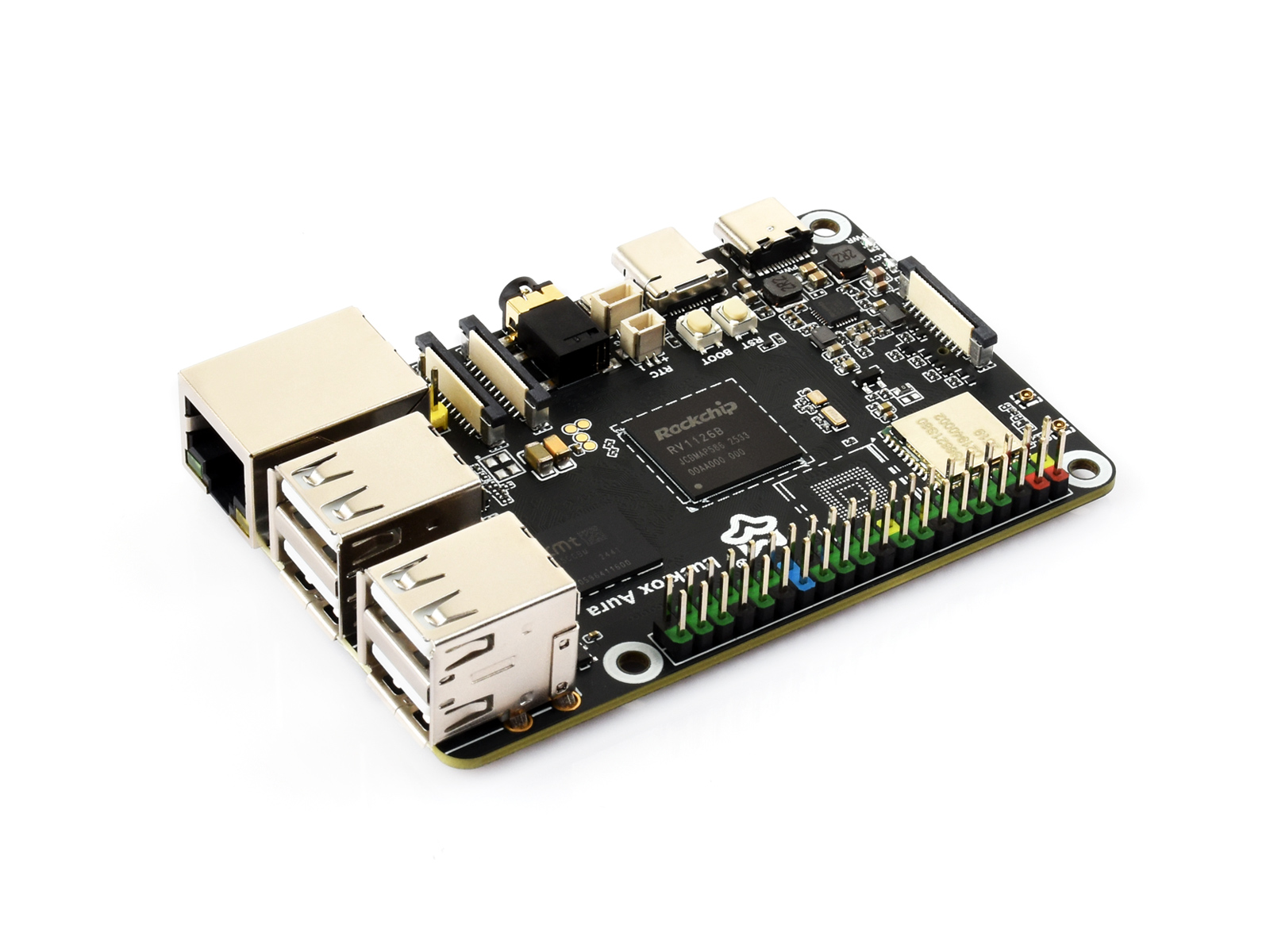
Luckfox
Linux edge-vision board with a quad-core 1.6 GHz RV1126B, 3 TOPS NPU, 2 GB LPDDR4X, 64 GB eMMC, dual four-lane CSI, DSI, Wi-Fi 6, Bluetooth 5.4, Gigabit Ethernet with PoE expansion, five USB ports and a 40-pin header.
Luckfox-Aura-02064Development boardFacts about the complete product. Unknown values remain open design questions.
Guidance to help you shortlist. The basis is shown for each recommendation.
On-board radio: dual-band Wi-Fi 6; Bluetooth 5.4 and BLE.
Engineering inferenceA 3 TOPS NPU, 12 MP ISP, and two four-lane CSI inputs support multi-camera visual inference.
Engineering inferenceThe board supports Buildroot and Debian 13 with 2 GB LPDDR4X and 64 GB eMMC.
Engineering inferenceGigabit Ethernet plus IEEE 802.3af PoE expansion support a single-cable deployed camera node.
Engineering inferenceThe 3 TOPS NPU, camera interfaces, microphone, and RKNN tooling support local multimodal inference.
Engineering inferenceThe USB 3.0 Type-C connector explicitly supports OTG operation.
Engineering inferenceThe board is the parent product. Each chip has its own memory, pins, capabilities and thermal limits.
Rockchip
7a981716-a740-52dd-84a2-790f9dd499f0--mcuThe Luckfox Aura 2GB/64GB is built around the RV1126B.
26 GPIO pins are exposed. Xirkit documents 40 board pins, 28 of them with pin-level electrical limits.
No. The I/O pins are not 5 V tolerant — they run at 3.3 V logic; use a level shifter for 5 V signals. Input-high threshold: ≥ 2 V.
Supply range 5–5 V. Power inputs: 5V, 5V.
From $111.99 at Luckfox. Prices are observed unit prices before tax and shipping.
85 × 56 mm. A STEP model is available for enclosure fit checks.
i2c, pwm, uart, spi.
Supported frameworks: Buildroot, Debian 13, RKNN.
Every value in this record is traced to a source — 2 documents including the board and chip datasheets — with the page and table cited per value. Unknowns are left explicit, never guessed.