Connected IoT devices and wireless sensor nodes
On-board radio: Wi-Fi 6 and Bluetooth 5.4.
Engineering inference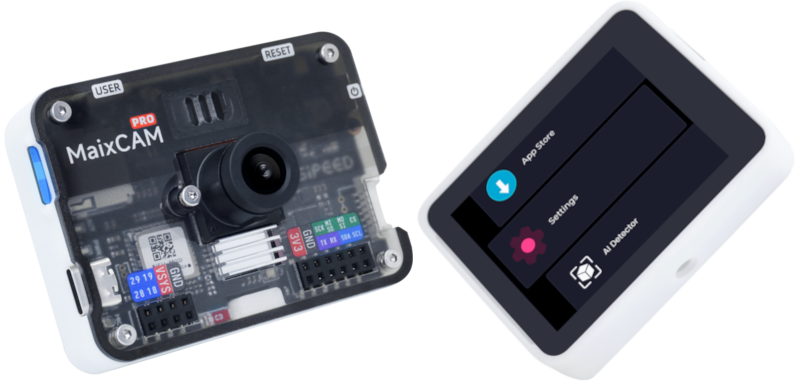
Sipeed
Self-contained edge-AI vision and audio development board with SG2002, 1-TOPS NPU, camera, 2.4-inch touch display, microphone, speaker, six-axis IMU, RTC, Wi-Fi 6, Bluetooth 5.4, battery management and PMOD expansion.
MaixCAM-ProDevelopment boardFacts about the complete product. Unknown values remain open design questions.
Guidance to help you shortlist. The basis is shown for each recommendation.
On-board radio: Wi-Fi 6 and Bluetooth 5.4.
Engineering inferenceThe on-board camera and 1 TOPS INT8 NPU support self-contained visual inference.
Engineering inferenceThe six-axis QMI8658 IMU, microphone, camera, and NPU provide local motion, audio, and image inputs for inference.
Engineering inferenceThe 1 GHz application core, microphone, speaker, and hardware NPU support real-time audio and control workloads.
Engineering inferenceThe USB 2.0 Type-C connector explicitly supports both device and host modes.
Engineering inferenceThe board is the parent product. Each chip has its own memory, pins, capabilities and thermal limits.
SOPHGO
38029236-d5d5-59fa-b2d5-42a7e3acab58--mcuThe Sipeed MaixCAM-Pro is built around the SG2002.
16 GPIO pins are exposed. Xirkit documents 24 board pins, 16 of them with pin-level electrical limits.
No. The I/O pins are not 5 V tolerant — they run at 3.3 V logic; use a level shifter for 5 V signals. Input-high threshold: ≥ 2.063 V.
Documented output-high current per pin: 5–10.5 mA. Values are traced to the chip datasheet; see the pinout table for per-pin limits and conditions.
Supply range 5.5–5.5 V. Power inputs: VSYS, VBUS.
From $133.71 at Ai-Paipai. Prices are observed unit prices before tax and shipping.
56.48 × 41.07 mm. A STEP model is available for enclosure fit checks.
gpio, spi, uart, pwm, i2c, debug.
Supported frameworks: MaixPy, MaixCDK, MaixVision.
Every value in this record is traced to a source — 2 documents including the board and chip datasheets — with the page and table cited per value. Unknowns are left explicit, never guessed.