Connected IoT devices and wireless sensor nodes
On-board radio: optional Wi-Fi 6 and Bluetooth 5.
Engineering inference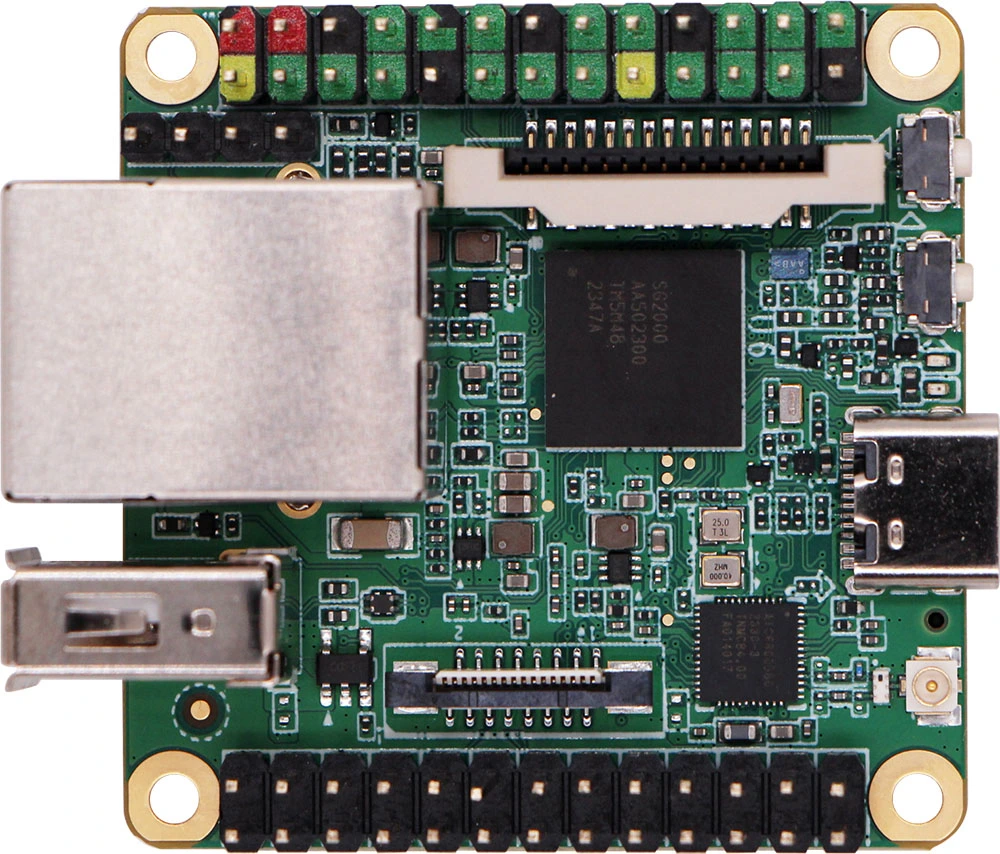
Milk-V
Compact edge-vision SBC with an SG2000 processor, 512 MB RAM, a 0.5-TOPS INT8 TPU, dual 2-lane MIPI CSI camera inputs, MIPI DSI output, 100 Mbps Ethernet, USB host/device modes and switchable RISC-V or Arm execution.
Milk-V Duo SDevelopment boardFacts about the complete product. Unknown values remain open design questions.
Guidance to help you shortlist. The basis is shown for each recommendation.
On-board radio: optional Wi-Fi 6 and Bluetooth 5.
Engineering inferenceNative camera interface on the main chip.
Engineering inferenceThe manufacturer guide documents USB device mode, and the SG2000 exposes a USB device controller.
Engineering inferenceThe 1 GHz application core and exposed I2S signals support audio DSP and deterministic peripheral control.
Engineering inferenceThe board is the parent product. Each chip has its own memory, pins, capabilities and thermal limits.
SOPHGO
41dbf10e-beaa-5d1f-9cc3-8bdea4bb0c0a--mcuThe Milk-V Duo S is built around the SG2000.
33 GPIO pins are exposed. Xirkit documents 83 board pins, 57 of them with pin-level electrical limits.
No. The I/O pins are not 5 V tolerant — they run at 3.3 V logic; use a level shifter for 5 V signals. Input-high threshold: ≥ 2.063 V.
Documented output-high current per pin: 5–10.5 mA. Values are traced to the chip datasheet; see the pinout table for per-pin limits and conditions.
Supply range 5–5 V. Power inputs: 3V3, 3V3, 3V3, 3V3, VSYS(5V), VSYS(5V), VSYS(5V), 3V3.
From $9.99 at arace.tech. Prices are observed unit prices before tax and shipping.
43.18 × 43.18 mm. A STEP model is available for enclosure fit checks.
camera, gpio, pwm, i2c, uart, spi, jtag, display.
Supported frameworks: Caffe, PyTorch, ONNX, MXNet, TensorFlow Lite.
Every value in this record is traced to a source — 2 documents including the board and chip datasheets — with the page and table cited per value. Unknowns are left explicit, never guessed.