Robotics and CAN-bus motor control
3 CAN interfaces plus hardware quadrature decoders — talk to motor drivers and ODrive/VESC-style controllers directly.
Engineering inference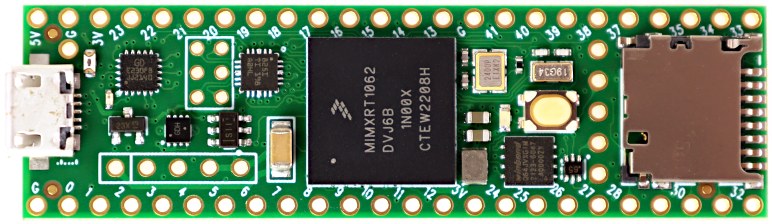
PJRC
PJRC Teensy 4.1: NXP i.MX RT1062 Cortex-M7 at 600 MHz, 7936K flash, 1024K RAM, 55 I/O (35 PWM, 18 analog), 8 serial / 3 SPI / 3 I2C, 3 CAN (1 FD), 2 I2S + S/PDIF, 10/100 Ethernet PHY, micro-SD (SDIO), USB device + host at 480 Mbit/s, QSPI pads for PSRAM/flash; 3.3 V I/O (not 5 V tolerant); 61×18 mm breadboard form. Strong fit for robotics: 4 hardware quadrature decoders, 3 CAN buses, many PWM groups.
TEENSY41Development boardFacts about the complete product. Unknown values remain open design questions.
Guidance to help you shortlist. The basis is shown for each recommendation.
3 CAN interfaces plus hardware quadrature decoders — talk to motor drivers and ODrive/VESC-style controllers directly.
Engineering inferenceEthernet interface for deterministic, wired links.
Engineering inferenceUSB is on the main chip (MIMXRT1062DVJ6B), so the board can enumerate as a keyboard, MIDI device or CDC serial port.
Engineering inferencePrograms from Arduino.
Engineering inferenceThe board is the parent product. Each chip has its own memory, pins, capabilities and thermal limits.
NXP Semiconductors
988c93b9-e010-52f5-a705-19fb5583bd0a--mcuWinbond
988c93b9-e010-52f5-a705-19fb5583bd0a--flashTexas Instruments
988c93b9-e010-52f5-a705-19fb5583bd0a--phyGigaDevice
988c93b9-e010-52f5-a705-19fb5583bd0a--u2Texas Instruments
988c93b9-e010-52f5-a705-19fb5583bd0a--u4The Teensy 4.1 is built around the MIMXRT1062DVJ6B, alongside W25Q64JV-DTR (8 MB), DP83825I, GD32E230F8 (after June 2022), TLV75533P (after March 2023; earlier TLV75733P / NCV8186AMN330TAG).
55 GPIO pins are exposed. Xirkit documents 80 board pins, 55 of them with pin-level electrical limits.
No. The I/O pins are not 5 V tolerant — they run at 3.3 V logic; use a level shifter for 5 V signals. Input-high threshold: 2.31–3.3 V.
Documented output-high current per pin: ≤ 4 mA. Values are traced to the chip datasheet; see the pinout table for per-pin limits and conditions.
Supply range 3–5.5 V. Power inputs: VIN (3.6–5.5 V), VBAT, VUSB.
From $29.95 at www.adafruit.com (2 supplier offers tracked). Prices are observed unit prices before tax and shipping.
60.96 × 17.78 × 1.57 mm. A STEP model is available for enclosure fit checks.
gpio, interrupt, adc, pwm, can, i2s, uart, i2c, audio, spi, led, sdio, qspi, control, usb, ethernet.
Supported frameworks: Arduino (Teensyduino), Makefile / command line.
Every value in this record is traced to a source — 3 documents including the board and chip datasheets — with the page and table cited per value. Unknowns are left explicit, never guessed.